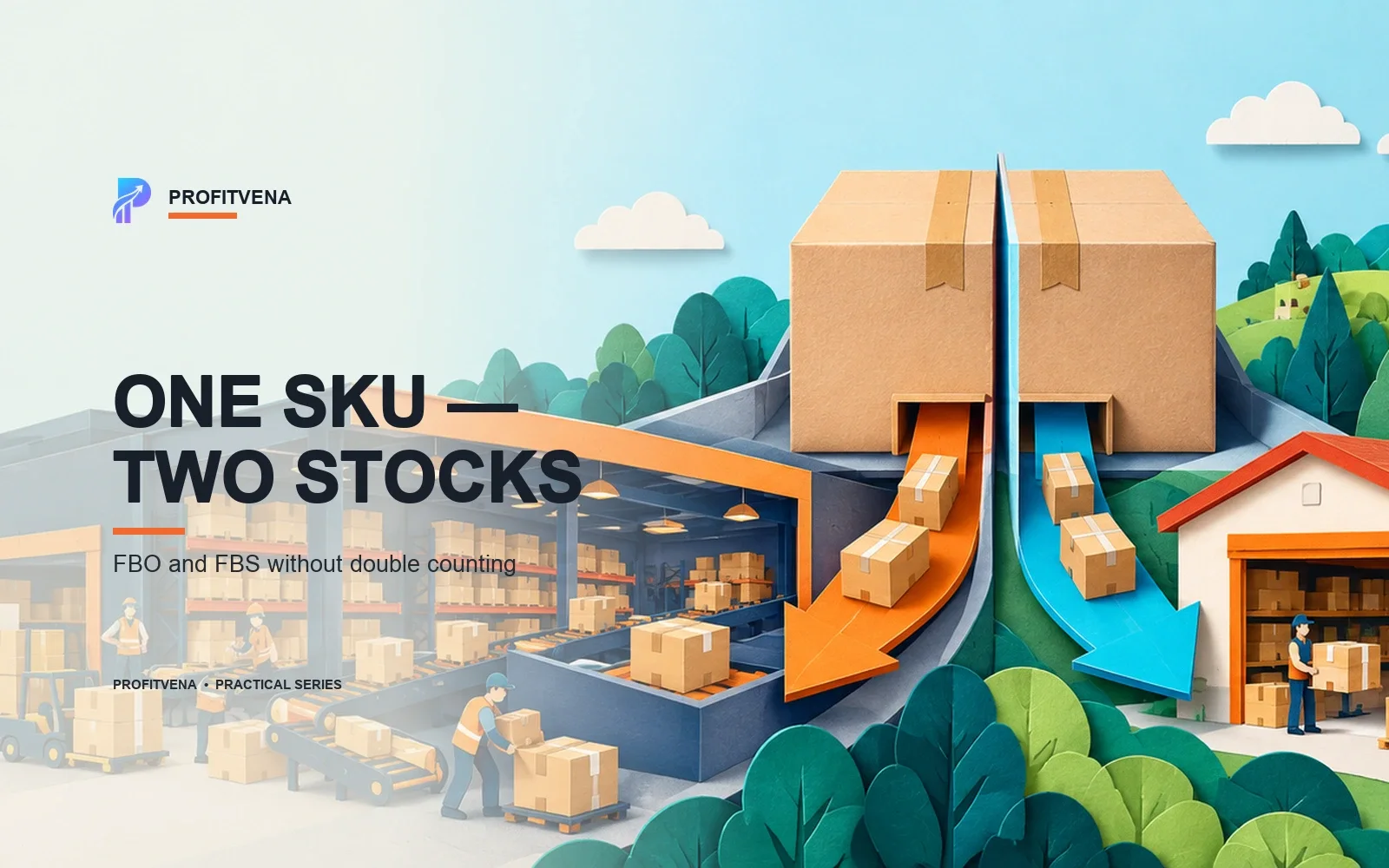
A central warehouse holds 200 units. The seller plans to send some to the platform warehouse and keep the rest for seller-fulfilled orders. With one shared inventory column, the same physical unit can easily be promised to both channels.
FBO and FBS planning starts with physical location, availability status and fulfilment responsibility.
Clarify the fulfilment vocabulary
FBO is a useful industry label for operator-held inventory, but platforms use their own names. Wildberries calls its warehouse model FBW, while Yandex Market uses FBY. FBS generally means seller-held and seller-packed inventory, but timing, statuses and constraints come from each platform and contract.
An internal model may use “operator warehouse” and “seller warehouse.” Keep the official scheme name, platform, account, warehouse, region and rule-effective date beside it.
1. Separate responsibility
| Control | Operator warehouse (FBO/FBW) | Seller warehouse (FBS) |
|---|---|---|
| Physical storage | platform after accepted delivery | seller until dispatch |
| Stock source | platform report by warehouse and status | internal records and published channel limit |
| Availability | after receiving and put-away | after reservation and successful synchronization |
| Main risk | regional shortage or excess | overselling, cancellation or late dispatch |
Use one SKU catalog, but preserve separate inventory sources and promise rules.
2. Track states, not one number
For every SKU, warehouse and model, keep physical, available, reserved, blocked, quarantined, damaged, expired, returned and confirmed-inbound quantities.
Available = physically good − reservations − blocks − quarantine − damage − expiry.
Do not subtract reservations twice if the source already excludes them from “available.” When one warehouse serves several channels, use a shared limit or atomic reservation.
3. Calculate targets separately
An operator-warehouse target depends on regional demand, full delivery and receiving lead time, review cycle, safety stock, capacity and shelf life.
FBO deficit = max(0, target stock − operator available − confirmed inbound).
An FBS target depends on demand until replenishment, open orders, packing speed, stock-update frequency and other channels using the same warehouse. Never publish a channel limit above truly free stock.
4. Never count inbound twice
Inbound passes through plan, request, confirmation, dispatch, transit, arrival, receiving, put-away and availability. Include only a documented status in the calculation.
Moving 60 units from central stock to the platform reduces seller availability by 60. It does not create new units. A delivery plan is also not confirmed inbound.
5. A return is not yet available stock
A returned unit may be in transit, at a separate return location, under inspection or blocked. Add it back to available inventory only after location and condition are confirmed.
Worked allocation example
The seller holds 240 central units: 30 are reserved and 10 under inspection, leaving 200 available. The operator-warehouse target is 170; 90 are available there and 20 are confirmed inbound. The FBS target is 120.
| Step | Calculation | Result |
|---|---|---|
| Central available | 240 − 30 − 10 | 200 |
| Operator deficit | 170 − 90 − 20 | 60 |
| After allocation | 200 − 60 | 140 |
| Buffer above FBS target | 140 − 120 | 20 |
The 60 units are a transfer candidate, not an automatic shipment. Check receiving capacity, packaging, cost, regional demand, shelf life and actual availability date. This is an illustrative example, not a volume recommendation.
Set a control rhythm
- Daily: FBS freshness, reservations, cancellations, synchronization errors and late dispatches.
- Several times weekly: operator-warehouse deficits, inbound status and expected availability.
- Weekly: SKU reallocation, returns, excess and constraints.
- Monthly: turnover, storage, lost demand, write-offs and parameter quality.
Before a bulk action, check one SKU, model, warehouse, region and snapshot time. Record the decision owner and rollback path.
Where ProfitVena helps
Product 360 shows products in the context of live Wildberries sales, returns, inventory and health signals within connected-source coverage. Profit Engine helps test whether SKU economics can sustain the selected fulfilment and storage approach.
For Wildberries, use official statuses and the FBW term where it applies to the operation. Forecast Center is preparing for integration and is shown as a preview; other marketplaces remain on the roadmap until confirmed. ProfitVena does not create an automatic shipment from this calculation.
Technical part updated in ProfitVena.
ProfitVena is part of the Wicsora ecosystem.
Detailed educational methodology and worksheet: FBO and FBS inventory planning.
Previous article: AI You Can Trust.
This article completes the practical ProfitVena series on profit, reporting, forecasting, data and inventory.