
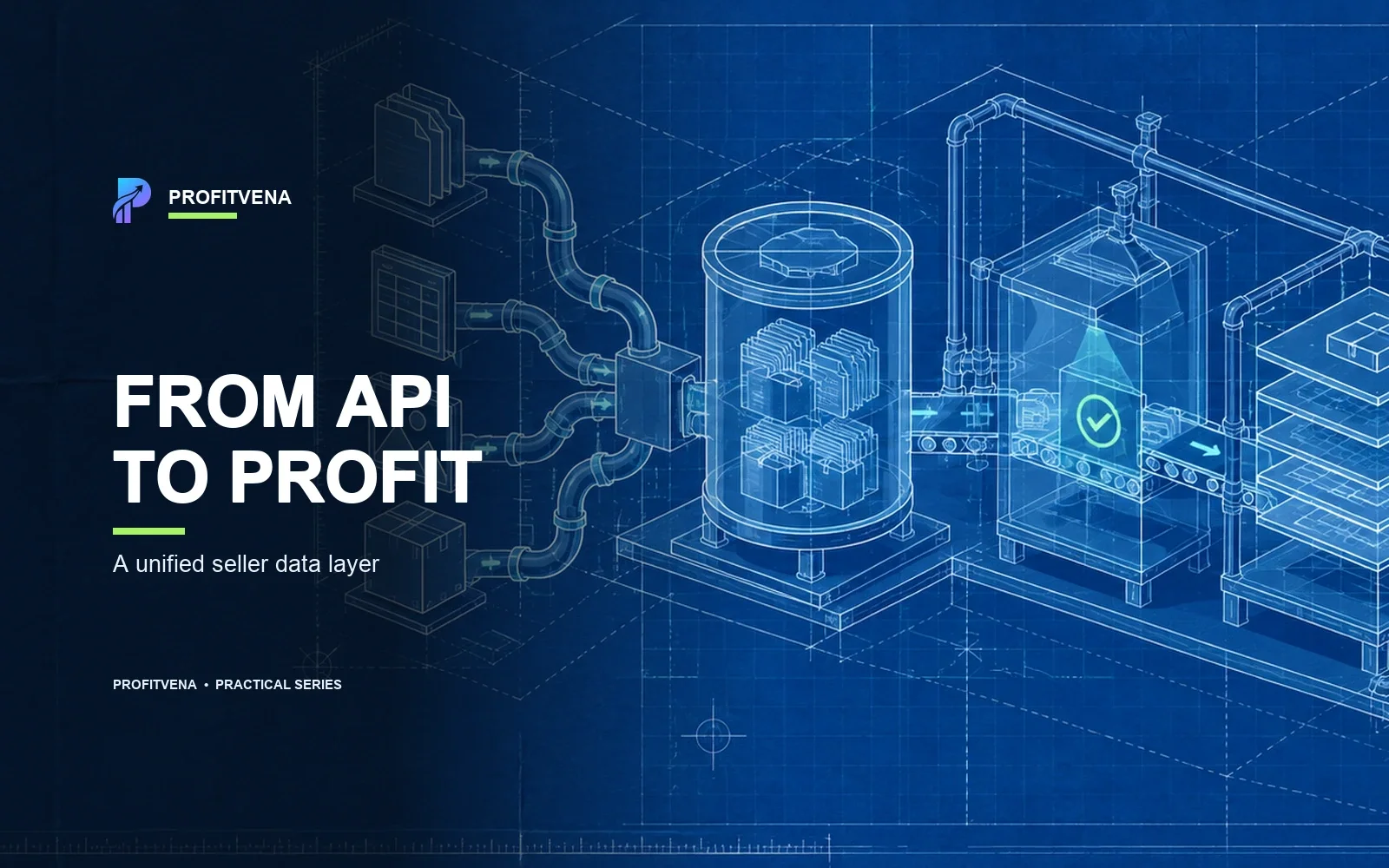
A seller can have many spreadsheets and still lack one reliable version of the truth. Orders sit in one report, returns in another, advertising in a third and product cost in an internal system. When totals disagree, the team debates numbers instead of making decisions.
A unified data layer is a reproducible path from APIs, files and internal operations to metrics, reports and actions. It should answer three questions: where did the number come from, which rule produced it and who approved its use?
1. Start with a decision
Choose a management question first: which SKUs lose profit, where stockout risk is rising, why a settlement does not reconcile, which ad campaign needs review or what belongs in the replenishment plan.
Define the required freshness, detail, accepted variance and decision owner. Data collected without a purpose quickly becomes an expensive archive.
2. Write a contract for each source
Record the platform, account, API or report, version, row grain, stable key, deduplication rule, timestamps, time zone, pagination and owner. Column names alone are not definitions; the same label may represent different events in different reports.
3. Separate events, snapshots and documents
An order status change is an event. Stock at 09:00 is a snapshot. A settlement report is a period document. A snapshot is not complete history, and an event is not current state without processing rules.
Preserve source event time, source update time, receipt time and load-run ID. Late data can then enter the correct period by policy instead of accidental import time.
4. Preserve the raw layer
Store each API response or file before business transformations, together with request parameters, period, page or cursor, checksum, timestamp and loader version. Re-running a load must not duplicate facts. Never place passwords, tokens or temporary signed links in this layer.
5. Normalize meaning without erasing evidence
Map accounts, contracts, warehouses, internal SKUs and marketplace IDs. Product names make poor keys because they change and may repeat.
Keep each original operation type and sign beside its normalized value. Preserve currency and precision for money, and original value and time zone for timestamps. Version every transformation rule.
6. Quarantine unknown data
A new column, unknown operation, invalid date or unmapped SKU should not silently become zero or “other.” Quarantine the row with its reason, amount, owner and resolution deadline.
Define the threshold and response in advance: continue, publish with a warning, retain the previous view or stop the calculation.
7. Measure data quality
Check completeness, uniqueness, validity, freshness, reference consistency and reconciliation. Every alert needs an owner and deadline; notification alone is not a control.
8. Follow a worked load
Suppose a file contains 1,000 operations totaling ₽1,250,000. Controls find two exact duplicates worth ₽10,000 and three unknown operations worth ₽15,000.
| Stage | Rows | Total |
|---|---|---|
| Raw layer | 1,000 | ₽1,250,000 |
| After deduplication | 998 | ₽1,240,000 |
| Quarantine | 3 | ₽15,000 |
| Published view | 995 | ₽1,225,000 |
Once the new mapping is approved, the three rows can be reprocessed. The result becomes 998 rows and ₽1,240,000 without manually editing the report. This is an illustrative example, not customer data.
9. Preserve the path behind every number
Each analytical row should reveal its source, load run, raw key, normalization version and publication time. An aggregate should link to its fact set and control reconciliation.
The question “why did profit change?” then has a testable answer: which operations arrived, which rule ran and what changed from the previous version.
Where ProfitVena helps
ProfitVena connects live Wildberries data in Product 360 and Profit Engine within connected-source coverage. This working layer helps teams move from scattered rows to SKU context and profit calculations while retaining evidence behind the inputs.
Wildberries is live. Forecast Center is preparing for integration and is shown as a preview; other marketplaces remain on the roadmap until confirmed. ProfitVena does not replace accounting records, platform contracts or accountable human approval.
Technical part updated in ProfitVena.
ProfitVena is part of the Wicsora ecosystem.
Detailed educational methodology: Unified seller data layer.
Previous article: When to Reorder.
Next: how to use AI analytics while keeping control.