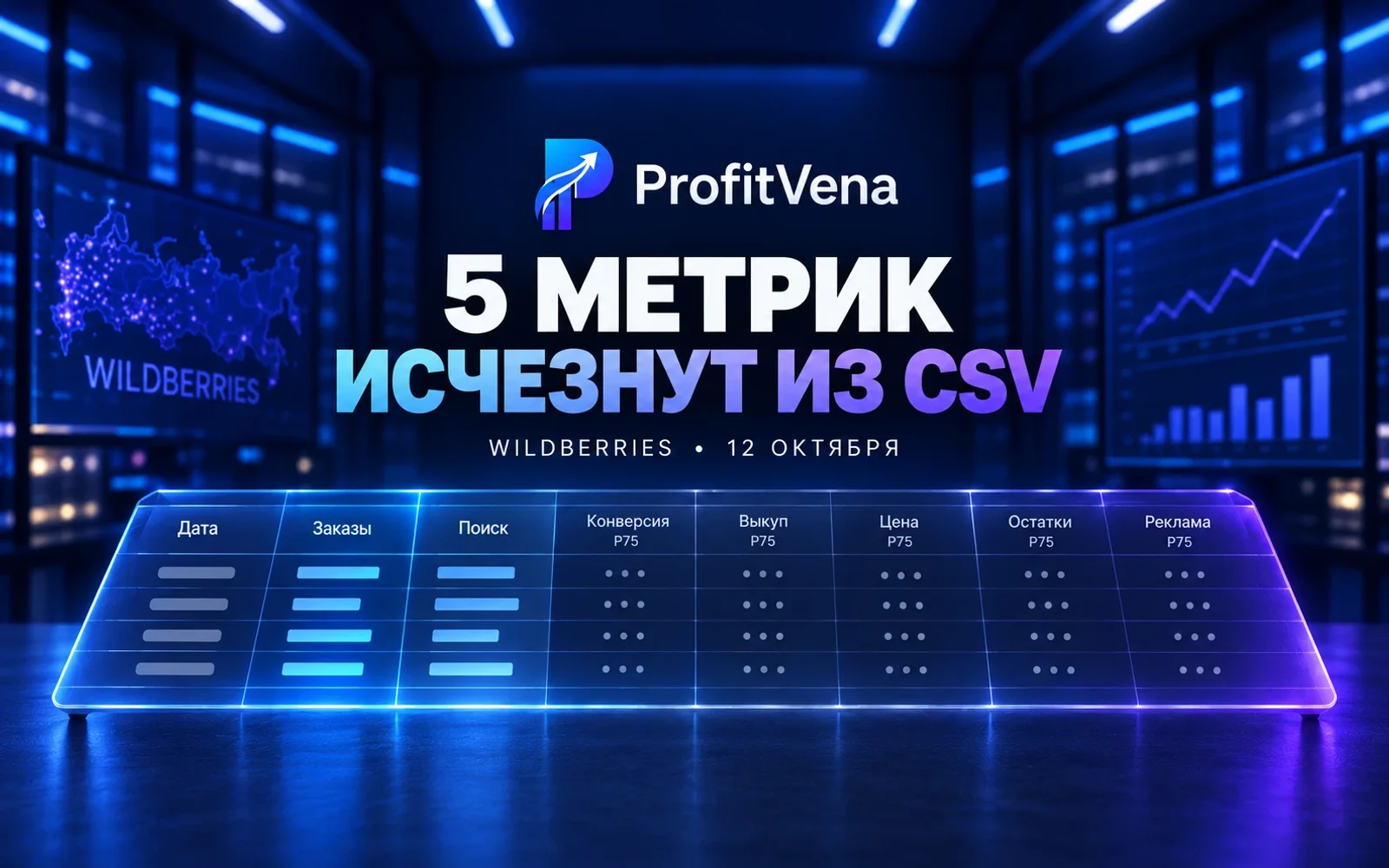
Wildberries will remove five comparative CSV metrics on October 12: what to check
The main risk is not losing five numbers. It is misreading an absent field as a zero. A spreadsheet or importer that substitutes 0 can create a false downward trend and trigger an unsupported recommendation.
Wildberries announced that, from October 12, 2026, five fields will disappear from the SEARCH_QUERIES_PREMIUM_REPORT_TEXT CSV downloaded through GET /api/v2/nm-report/downloads/file/{downloadId}: OpenCardPercentile, AddToCartPercentile, OpenToCartPercentile, OrdersPercentile and CartToOrderPercentile. They described a listing’s relative performance against other sellers’ listings for a search query.
Who should check their reports?
Anyone importing that search-query report into Excel, BI or an analytics service should inspect formulas, charts and alerts that use those fields. Importers that depend on column positions, or convert blanks to zero, deserve special attention.
The announcement concerns this particular CSV. It does not say that all search data or a seller’s own metrics will disappear. But a store’s own conversion rate is not a replacement for a marketplace-relative percentile: the denominators and meaning differ.
A practical checklist before October 12
- Keep a sample of the current CSV, with its download date, and identify every formula and alert using the five fields. Preserve existing historical values with their source period.
- Test ingestion without those columns. Parse by header name, tolerate reordered or extra columns, and keep unaffected metrics flowing.
- Show “no longer supplied by WB” rather than zero. Zero is a measured value; an absent column is a data-availability state.
- Disable or rewrite recommendations that require a comparison with other sellers. Do not carry the last historical percentile forward as if it were current.
- After the change, compare row counts, dates and remaining store metrics. Mark the methodology break on historical charts.
Suppose a comparative listing-open metric was 18% for one query before the change. If the field is absent after October 12, that is not a fall from 18% to 0%. Keep the historical observation and mark the new point unavailable. This is an illustrative example, not a seller result.
Our related guide explains why zero and missing data lead to different profit conclusions. The same distinction matters in search analytics.
Where ProfitVena fits
Analytics should preserve a metric’s source and explain when a connected source stops supplying it. The effect on any specific account depends on its connection and report availability. We are not claiming an automatic substitute for WB’s retired comparison fields. ProfitVena helps examine SKU economics and available data quality as part of the Wicsora ecosystem.
Verified October 6, 2026. Official WB API notice. Recheck the current WB API documentation when the change takes effect.