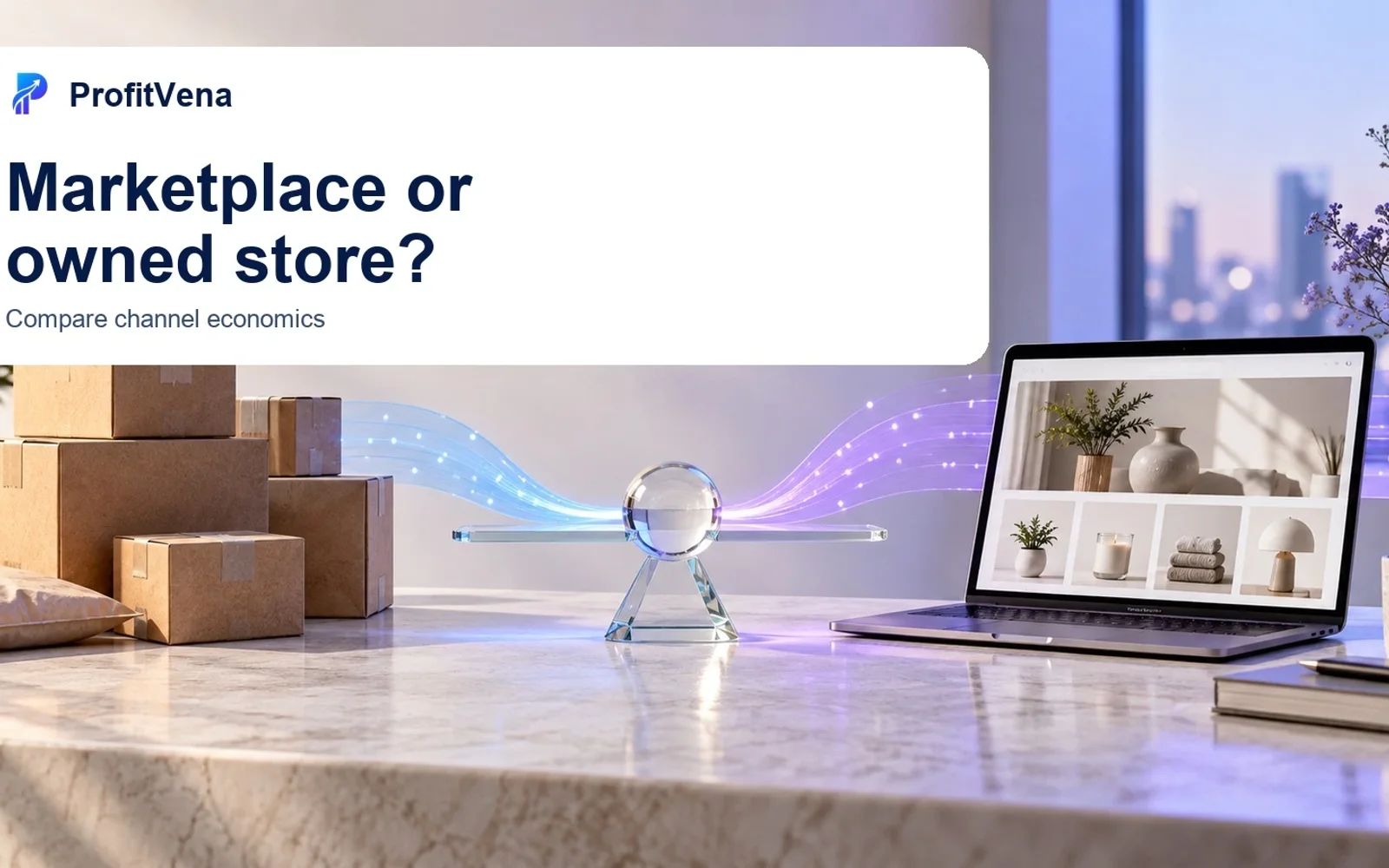
A marketplace fee is easy to see. The cost of winning and keeping a customer in your own store is less obvious. ProfitVena Channel Economics puts both channels into a comparable model, saves versioned assumptions, and keeps imported store observations separate from the scenario you are testing.
Make the comparison fair
Use the same period and currency. Separate revenue, variable costs, and allocated fixed costs for each channel. On a marketplace, inspect fees, fulfilment, storage, advertising, and returns. For an owned store, include acquisition, payment processing, delivery, returns, support, software, and cost of goods. Apply a consistent revenue-recognition rule, and never count a customer order in both channels merely because it moved from one to the other.
The model uses contribution = revenue − variable costs and profit after allocated costs = contribution − allocated fixed costs. If illustrative revenue is ₽100,000, variable costs ₽65,000, and allocated fixed costs ₽10,000, the resulting figure is ₽25,000. These are hypothetical manual inputs, not customer performance. The calculation method defines the boundaries.
Test three versions, not one headline number
Create marketplace, owned-store, and combined scenarios. Change one assumption at a time—for example, acquisition cost or return rate—and save the version. Compare contribution and profit after allocated costs rather than treating a marketplace commission as the sole alternative to ad spend. A combined scenario adds the entered channels; it does not establish that a store will generate incremental demand instead of shifting orders away from the marketplace. Follow the scenario guide for the workflow.
Bring in observations without turning them into forecasts
The owned-store import accepts CSV, TSV, and native Excel .xlsx files for orders and costs. Map columns, inspect rejected rows and duplicate warnings, reconcile the period and selected totals against an independent source export, and explicitly commit the import. Re-uploading the same file should not duplicate financial lines. Imported observations do not silently overwrite a saved manual scenario.
A match on selected totals is not proof that every cost and return is accounted for. When only some expenses are known, describe the result as a partial known-cost view. Check source coverage, freshness, and lineage before calling a number profit. The import guide and data-lineage method explain what each check establishes.
Include the customer economics only when the data supports it
CAC requires acquisition spend and a nonzero count of new customers. Repeat rate, contribution LTV, LTV/CAC, and payback depend on mature cohorts and sufficiently complete seller-owned first-party data. If identity, spend, or repeat orders are missing, the metric is unavailable—not zero. Avoid subtracting acquisition spend again when it is already included in channel costs. The customer-economics method explains these limits and privacy boundaries.
Know which connected capabilities require setup
Scenarios, saved versions, and file imports are part of Channel Economics when the feature is available to the workspace. Read-only Google Sheets snapshots, reviewed InSales connections, signed Store API events, customer cohorts, marketplace evidence qualification, and the grounded AI brief are separately controlled by workspace eligibility and source readiness. Documentation does not mean every capability is enabled for every customer. A hidden control is not a zero-value observation or a failed import.
Cart and checkout events are funnel observations, not recognized revenue or profit. An API 202 response means accepted for processing, not published financial data. See the connected-sources guide and event-recognition rules.
Where ProfitVena Intelligence is enabled, its channel brief can explain validated drivers, a modeled break-even point, missing measurements, and the next analysis with evidence references. It must not invent missing figures or change prices, ads, orders, tax settings, or channel allocation. Read the AI-brief guide.
A useful first step: open Channel Economics, set a comparable period, and build two cost versions. Mark which values are assumptions and which have been reconciled to a source. That distinction is the foundation of a defensible channel decision.